
Daily Supplements
Vitamin D, Magnesium, and the Architecture of a Morning Stack
Marcus Webb
·
Physical Output
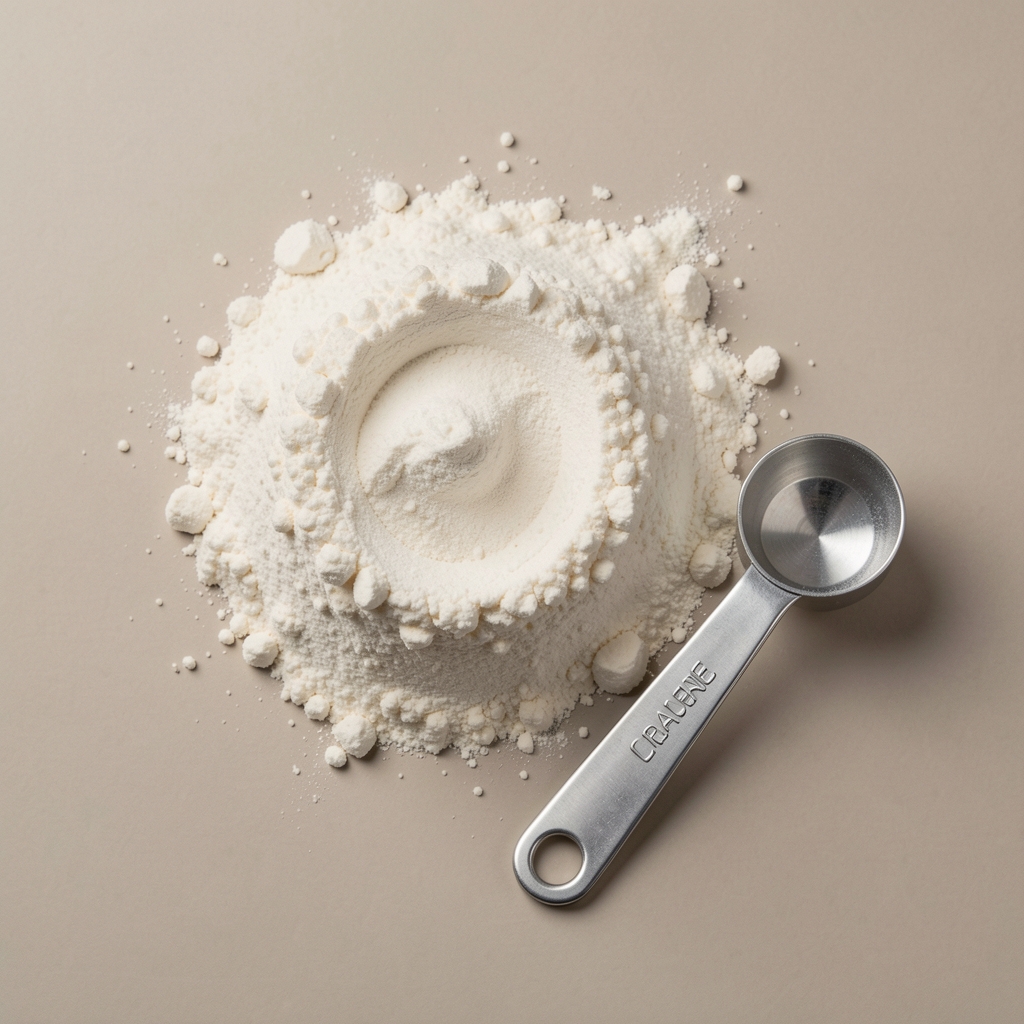
— Editorial still, February 2026
Few supplements in men's nutritional literature have accumulated as substantial a research record as creatine. Its documented relationship with physical output in resistance training contexts spans decades of published nutritional and sports science literature, making it one of the most comprehensively reviewed ergogenic nutrients available without a professional directive.
The published research record on creatine and physical output is among the most consistent in sports nutrition. The central observation across multiple published studies is that creatine supports physical output over time in resistance training routines. This means that the benefit is not immediate — it accumulates across consistent use, typically over a period of several weeks, as creatine stores in muscle tissue reach a higher steady-state level.
What creatine does, according to published nutritional literature, is expand the capacity of the phosphocreatine energy system — the short-duration, high-intensity pathway the body uses during brief bursts of physical effort. In practical terms for men engaged in resistance training, this translates to the capacity to perform more repetitions at a given load before fatigue sets in, or to maintain output across repeated sets over a training session.
Content published by udravel Journal is selected based on published nutritional research and reviewed for editorial accuracy by a second editor before publication. Observations on supplement function are editorial in nature and not directives for personal practice.
Among men who train with weights regularly — whether at a gym or at home — creatine has become one of the most discussed supplements in the nutritional toolkit. The editorial record across independent men's nutritional publications consistently positions creatine alongside protein as a foundational element of a performance-focused supplement stack. This positioning is informed by the research literature, which attributes a measurable contribution to physical output to consistent creatine use over time.
Gym nutrition for men encompasses a broader context than supplements alone. Published guides on the subject consistently emphasise that creatine supplementation produces its clearest observable effects when it sits within a nutritional environment that also includes adequate protein intake, hydration, and caloric sufficiency. In isolation — that is, taken alongside a nutritionally poor diet — the observable contribution is reduced.
This contextual point is one that editorial supplement reviews often under-emphasise. The supplement does not act independently of the overall diet. Its contribution to physical output is observed in conjunction with the nutritional baseline, not despite it.
"The supplement does not act independently of the overall diet. Its contribution to physical output is observed in conjunction with the nutritional baseline, not despite it."
— Resistance training context, editorial composition
The published literature on creatine consistently positions creatine monohydrate as the most thoroughly researched form. Multiple published reviews conclude that there is no substantive evidence that newer forms of creatine — various salts, esters, and buffered variants marketed under alternative names — outperform creatine monohydrate in supporting physical output. This is a significant editorial point: the supplement market for creatine is varied, but the research support is concentrated almost entirely in the monohydrate form.
For men building a supplement review practice — comparing products, evaluating forms, and aligning purchases with evidence — the research literature points to simplicity. Creatine monohydrate, taken consistently, represents the evidence-informed choice. The editorial recommendation across independent nutritional publications is to prioritise the form with the most published support over novel variants with limited independent research.
We recommend speaking with a qualified wellness or nutrition professional before introducing any new supplement habit or routine to your daily life, particularly if you have specific dietary requirements.
The question of creatine timing — whether to take it before training, after training, or at a fixed daily time unrelated to training — has been the subject of considerable published editorial debate. The research literature suggests that timing is less critical than consistency. What matters more than the specific window of intake is the daily regularity of the practice. Men who take creatine consistently at any point in the day accumulate the muscle creatine stores that underpin the performance contribution over time.
The loading phase — taking a higher daily amount for the first five to seven days before transitioning to a lower maintenance amount — is a protocol observed in a portion of the published literature. It produces a faster rise in muscle creatine stores. However, published research also notes that the same endpoint can be reached with a consistent daily amount over a longer period (three to four weeks), without the higher intake in the initial phase. Both approaches are represented in the evidence base.
For a supplement journalling practice, the practical question is which pattern supports daily consistency. The loading protocol requires a short period of elevated intake followed by a transition. The steady approach requires only a consistent daily habit. The editorial observation from independent nutritional publications is that the approach most likely to be maintained is the correct one — and that varies between individuals.
Creatine does not function in isolation within the supplement stacks documented in men's nutritional literature. It is most consistently paired with protein — either from whole food sources or from protein supplementation — as part of an integrated approach to gym nutrition for men. The published literature identifies a complementary relationship: creatine supports the energy system for physical output during training; protein supports the recovery and adaptation that follows.
This pairing reflects a broader principle in supplement stacking habits: the stack is more than the sum of its parts when each element addresses a different aspect of the training-recovery cycle. For men who train with weights, the cycle of effort and recovery is the fundamental rhythm of physical development. Creatine and protein, taken together in a considered daily routine, are documented in published nutritional literature as a coherent pairing for supporting physical output and daily performance over time.
The editorial position of udravel Journal is to observe this pattern and report it accurately, without overstating what the research supports. Creatine supports physical output over time in resistance training routines. That is the published finding. It does not act instantly, and its effects are specific to high-intensity, short-duration exertion rather than endurance activities. Understanding those boundaries is part of the evidence-informed approach to supplement review for men.
— Key Observations
— About the Author

Marcus Webb
Marcus Webb is a contributing editor at udravel Journal, focusing on men's nutritional habits and supplement journalling. His editorial approach draws on published nutritional research and observational reporting from active lifestyle contexts.
More from Marcus Webb